All posts by stinabrown

Stina Brown: Executive Coach, Process Designer + Facilitator, Organizational Development Designer/Trainer, and Artist in Residence

Raising the Standard: Conference Day Innovation

Seven Design Elements to Build Human Connection in Meetings

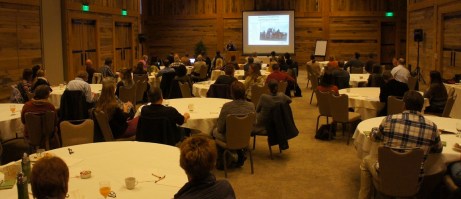
I arrived before the hundreds of participants, before the speakers took their place on the grand stage, and before the enormous background screen was lit up with countless images, text and camera zoom shots of the presenters on stage or Skyped in.

The collective event – the experience they shared – was one of listening. Conference goers, experts in their own right, listening to experts with a higher profile. Highly qualified keynotes, professionals in panels and dignitaries reading their speeches were given all the time in the day. There were over twenty presentations, varying in length from five to forty-five minutes. The dynamic the entire day, from 8:30 in the morning to 5:00 in the afternoon was audience-and-speaker. It was all PUSH.

Even if you have the best content, it’s still just content.
not-community

This experience was not unique. It was not unexpected. We have all been to that conference – heck, many of us have planned and led that conference. People didn’t get to share, or really ask questions, or hear from their colleagues from around the world beyond the handful on stage or in a video.

There was a cocktail reception offered at 5:00pm, and about a third of the people stuck around for a drink or a visit. One participant approached me at the reception and said he was exhausted from the day and regretted not getting to meet others in the room. “Unless you’re an A-type personality, you’re not networking right now, you’ve gone home.”

Granted, nowhere did this event tout itself as a community-building event, or an event about engagement of any kind. It was about innovation, but it wasn’t social innovation.

When you add up the time and effort – the actual financial cost, as well as the rare opportunity to have hundreds of people from the same industry – leading thinkers – in the same room for the whole day… why would you have them silent and listening the whole time?! Is this really the best use of a day and a room full of that kind of knowledge, innovation and human collaboration potential?

What if, when you brought people together, they could be fully present – not sitting and ignoring neighbours at their tables, tweeting questions that never get answered from the stage, or worse, checking their email or Facebook? What if people experienced a collective purpose in coming together, creating something new right in that room – new understanding, new achievable outcomes, new vision, inspiration or new connection for future collaborations?SONY DSC
What if innovation happens on the day of the conference, not just as a topic, keynoted retrospectively and beamed through a virtual presentation from Boston or Berlin?

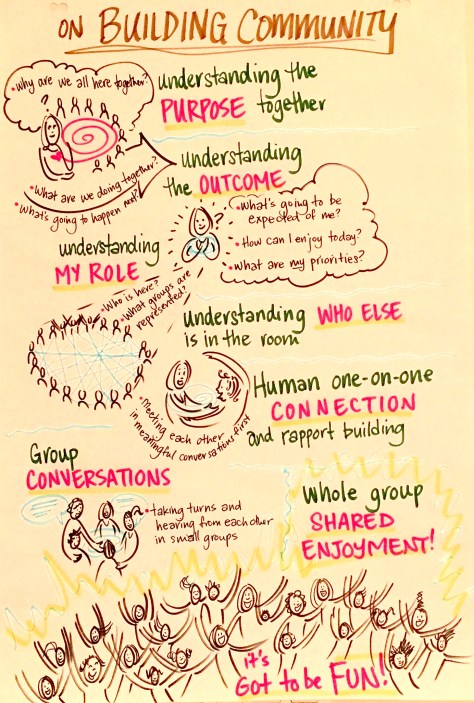
Design Elements to Build Human Connection in Meetings:

  1. Understanding the Purpose Together:
    When people come together, they likely do so with some idea of why they are coming together. But let’s make it explicit in the room. Address it with a question like: “Why are we all here together?” Frame the gathering around the people in the room, not around the subject. Too many events become self-important. On the day of the event, the only thing real is the people in the room. Give them that. People’s presence makes a meeting great. Too many meetings are full of absent people. Step one: give them a purpose for being present.
  1. Understanding the Outcome Together:
    Participants want to know, “What is going to happen here?” Yes, the agenda gives you an idea of this – but going a little deeper into it can help people participate more fully, see how they can best invest their attention and energy in the day. “What are we doing together?” “What will we accomplish today?” Give a flyover to add a meta perspective. Make it visual to allow extra engagement, creativity and complexity.
  1. Understanding My Role:
    Honour your participants by offering them time and space to consider: “What is expected of me?” “How can I enjoy today?” “What are my priorities in being here today?” Too many times, this part is skipped over. If you guide this process well, people can see themselves as included in the success of the day, and can share in the responsibility for a positive, participative outcome.
  1. Understanding Who Else is in the Room:
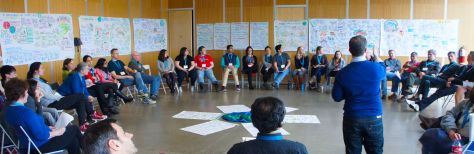
    This is almost always missed in big meetings. Knowing who else is in the room is one of the greatest resources in large groups. Shared awareness about who is at your table is the first step. Provide ways of showing the group who is there: participant lists with photos in a booklet, a big bio wall with photos, an app, table templates, name tags with extra info on them such as their hope for the day. Make it visible if possible. Have people move around. Call if out from the stage: “What groups are represented?” “Who is local?” “Who came from other communities?” Ask people “Who might you most want to connect with?” Leaving the masses stuck and silent at their tables is the worst use of their time.
  1. Human One-on-One Connection and Rapport Building:
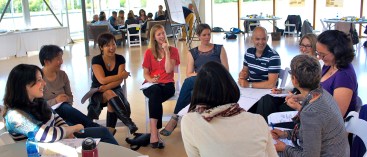
    Only confident extroverts introduce themselves all day to the folks they meet. Make the meeting fun and accessible from a relating point of view regardless of how introverted individual participants are. Start at the table level. Offer people meaningful conversation starters; inquiry that is relevant and interesting can create short but authentic moments of connection. For example, “Tell me about something you love about where you live or how you live?” The topic could also be something closer to the topic of the meeting – no matter, make it appreciative, energizing and short, just a minute or two for each person in pairs. Find ways to do this type of exercise several times with different questions to ensure more connections.
  1. Have Small Group Conversations:
    Taking turns hearing from each other in small groups increases understanding, creates a diversity of perspectives and fuels creativity and new relating. When all you have is speaker-audience communication, your “participants” habitually zone out into TV-watching mode, not relating mode. Those speakers are not responding in the moment to your eyes, your curiosity or even your boredom. Most of them have a canned presentation, with an introduction video, PowerPoint slides, and five to ten minutes to respond to the top tweeted questions. It’s not a human connection; it’s something else. But conferences don’t need to be ONLY THAT.We can be humans, relating to other humans, working to solve the most complex challenges of the day. Have conversations. Meet and listen to many people. Share your ideas. Change your mind. Open your heart to walking in others’ shoes over a cup of coffee. This is how community gets built at meetings.
  1. Shared Enjoyment:
    Finally, many of us don’t enjoy all-day meetings (gasp!). How can this change? What if those meetings are actually a day of discovering new ideas, meeting inspiring people, being seen and heard, being creative, learning or inventing new things – new methods solutions or possibilities, and… even something like singing or… dancing?! Well – it’s possible!

Set a new standard with your next meeting or conference. Break out of the default conference models, people. They suck. Nobody wants to sit at a round table all day ignoring their neighbours and listening to presentations from twenty-four people, let’s be honest.

So – let’s not. Instead, let’s be humans with each other. Let’s share and laugh and connect. Let’s tackle the complex challenges we have before us with courage, creativity and humility. Let’s open our minds to learn and be seen and heard. Enough with the anonymous PUSH conferences. Let’s build community with our meetings.

This is obviously not an exhaustive list of elements that build community in meetings, just a start. You could also consider: having a listserv for the group to stay in touch, plan future smaller gatherings, create topical groups, launch a follow up survey, create a community of practice or further points of connection. Please add your ideas or thoughts on how you build community through meetings in the comments section or email me directly. This is just the start of the conversation!

Contact Stina by calling 604-612-8563, email stina at stinabrown.com or fill out the form below.

Go back

Your message has been sent

Warning
Warning
Warning
Warning
Warning
Warning

Warning.

buildingcommunity

A Learning Journey Becomes a Book and a Community

lebb

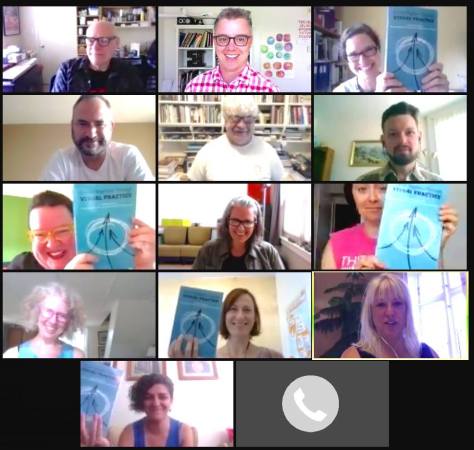
Last year I embarked on an adventure without even leaving the comfort of my home office. Sam Bradd asked me to join him and 25 other colleagues to write and publish an anthology on our flourishing yet somewhat unknown industry: “Visual Practice”. What began as a writing assignment for a 2,000 to 2,500 word essay has now become a connected and diverse talent pool of practitioners all over the world – oh, and a book! Drawn Together Through Visual Practice.

We celebrated locally in Vancouver this weekend, and many of you took part! Thank you!
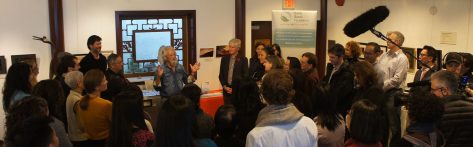
On October 29, 2016 the Gallery Gachet hosted somewhere around 50 of us. Four local authors were in attendance: co-editor Sam Bradd, and contributors Aftab Erfan, Stina Brown, and Aaron Johannes. We heard about the work being done by leaders in the field of facilitation, conflict mediation, education, and all other areas using visual process to establish common ground. Seasoned pro’s Avril Orloff and Corrina Keeling drew live at the event.


What many people might not know about “our” industry – the field of folks working away in meetings, retreats and conferences as visual thinkers, scribes, graphic recorders, facilitators and teachers – is that this is a profoundly generous and caring profession. In every case, the need to truly listen to what’s taking place in a room or meeting at any given time requires the full attention of the recorder and/or facilitator. There’s no “half-ass” in this business. We show up fully, for the sake of the meeting, the people, and our own high standards. There is a certain gentle power or “presence” in that – our full focus adds a quality of attention to what’s already happening in the room. Besides bringing creativity, visual practice elevates the energy, attention, retention and engagement in the room.

We as experts don’t often tell our stories – so often the meetings are confidential. But we come together in this book to share some of the mystery and magic we work within. My chapter is called: A Learning Journey – Connecting Self to Planet. You can download my chapter for free here. It’s based on four gatherings I led with the Climate Justice Project through the Canadian Centre for Policy Alternatives with Marc Lee. In this initiative, Marc, Sam and I guided a group of strangers toward self-determined transformation – connecting their individual experiences with each others’ to see themselves in relationship with the larger context of the planet and our collective future. It was an amazing eight weeks!

CCPA
A Conversation on Climate Justice

So, the next time you have an important meeting coming up; an initiative that you are leading or change you are hoping to create in the world – anything that involves getting groups of people together to relate or collaborate – consider this community of Visual Practitioners. We are here to serve! For more information, visit the International Forum of Visual Practitioners, pick up our book, or contact Stina directly: stina at stinabrown.com.

vp-book
A handful of the authors in Drawn Together Through Visual Practice

ENGAGEMENT: A Quick How-to Guide

I was in a conversation the other day when a colleague started telling me about her work challenges. She has recently become the point person in a health network that will bring together 400 people around the common cause of fighting a terrible disease. She was lamenting the line item in her budget: “Engagement”… “What does this even mean?” she asked. She was at a loss.

Engagement is a word thrown around by innumerable bodies these days. Simon Fraser University is “the Engaged University”, countless organizations have “Community Engagement” strategies and plans, and even individuals can be targeted for engagement in their learning, voting, citizenship, employment and parenting, etc.

Engagement can be defined differently for different organizations and situations – there is no one definition. It can be thought of as absorption of focus or concentration, relating or making meaningful connection. It could be about communication and investment of time and energy – taking action, for example.

SO, when an organization has “Engagement” as a line in their budget, what are the next steps?
I have outlined some options for anyone grappling with this question.

Define what Engagement means for your organization. Is it about…

  • Understanding an issue more deeply?
  • Building relationships within your network?
  • Creating a shared vision or plan?
  • Hearing from your constituents?
  • Creating a community of practice among peers?
  • Discovering new tools, methods or approaches in your work?
  • Gathering feedback or input?

Regardless of how you define it, there is always an element of trust required for healthy engagement. The people who are being invited to engage have to be able to trust the host or sponsor on some level. Trust may need to be restored prior to an engagement initiative if there was a wounding event or dynamic in the past.

Choose your Engagement Goals:

  • Why/how do you want your group or organization to become engaged?
  • What will the world look like if your people are engaged?
  • What are the benefits to your people and to the mission of your organization if people do become engaged?
  • What is the risk if your people are not engaged?

Consider your Methods of Engagement:

  • Online Meetings and Gatherings: We are able to reliably reach most people online for the most part these days, even with Zoom fatigue. To reach your engagement goals, an expert in facilitation for engagement can guarantee a quality design that helps you realize your priorities. “Regular” online meetings won’t cut it! A special approach is required to create captivating meetings.
  • Small group calls: Engaged meetings have all members participating, actively contributing and involved. You can work with graphic recorders, experienced facilitators or creative community members to make it memorable and meaningful.
  • Interviews: When even small meetings are not possible, you can conduct interviews online or by phone. Reach out and connect with team members to show them their ideas and input matters. Engage them in the conversations that will affect the future of the organization. Stina uses the Appreciative Inquiry Approach. Download this pdf on Asking Powerful Questions.
  • Surveys: This can be a very helpful step in an engagement process, but is less effective when it’s done as a stand-alone strategy for engagement. Depending on the size of your survey group, you can include questions that are open and not leading, giving each respondent an opportunity to share authentically and anonymously. These findings can be brought into any of the other methods outlined above, to help create shared awareness.

Evaluate your Engagement:

Don’t forget to put the metrics in place to measure your Engagement initiatives! There should be a return on your investment. This could look like increases in quantity and quality of strategic partnerships, better employee retention, improved performance in meetings and team dynamics or even a transformation in the workplace or organizational culture. Whatever the case, keep the communication going after the initial engagement “push” – because true engagement is about relationships. And those don’t end!

Hire an Engagement professional:

There are a small but passionate number of facilitators and consultants in the Metro Vancouver area who are dedicated to creating the settings for engagement to thrive. Qualified professionals should have proven experience at creating successful outcomes for their clients.

For more information on how Stina could serve your engagement needs email stina at stinabrown.com or fill out the form below.

Go back

Your message has been sent

Warning
Warning
Warning
Warning
Warning
Warning

Warning.


Quick Case Studies of Stina’s Design and Visual Facilitation Work with an Engagement Focus:

  • A Conversation on Climate Justice in BC: In late 2014, the Canadian Centre for Policy Alternatives asked Stina to design a series of four full-day meetings over the course of two months as an engagement aspect of their Climate Justice Project (CJP), led by Marc Lee, Senior Economist. The CJP “asks how we can tackle global warming with fairness and equality. Our challenge is to build a zero carbon society that also enhances our quality of life.” This series of “deliberative dialog sessions,” which took place in the Metro Vancouver area, was intended to advance the outreach work of the CJP and deepen understanding of effective engagement processes. It also held the potential for expanded activities across BC and Canada to spur climate action. Stina hired Sam Bradd for complimentary Graphic Recording services. For a full description of the facilitated sessions, you can download Stina’s recap here. To see other best-practices examples of “visual facilitation” in action, you can purchase or download the just published anthology Drawn Together Through Visual Practice.
A Conversation on Climate Justice
  • David Suzuki Foundation (DSF) – Sustainable Diversity Network Launch, Fall 2015. The Purpose of the event was to share DSF’s knowledge with their partners and allies, and empower them to integrate the findings of the Multicultural Report in their own public engagement work. To consolidate existing partnerships and form new relationships with ENGOs and new Canadians, strengthening the engagement of diverse communities in the green movement.
Sustainable Diversity Network Launch
DSF Sustainable Diversity Network Launch
  • Healthy Minds | Healthy Campuses Summit, March 11-12th 2016 in Vancouver. Stina provided live Graphic Recording Services for 2 Days of summit activities. This is visual and participant engagement which added a dimension of deepening the learning and memory of the people present. The added benefit of bringing this form of engagement into a meeting is offering people a visual record to share when the day is done, continuing the positive momentum and possibilities begun at an already successful event. Scroll to the bottom of this page to see images.
  • Abbotsford Community Services, Stina designed and facilitated a focused, fun and productive “Team Day” for Staff of Abbotsford Community Services, Multicultural and Immigrant Integration Services Division.
Abbotsford Community Services

To read what Stina’s clients have experienced, working with her, please visit Stina’s clients page.